Inside Shenzhen’s High-Tech Version of the Food Bank
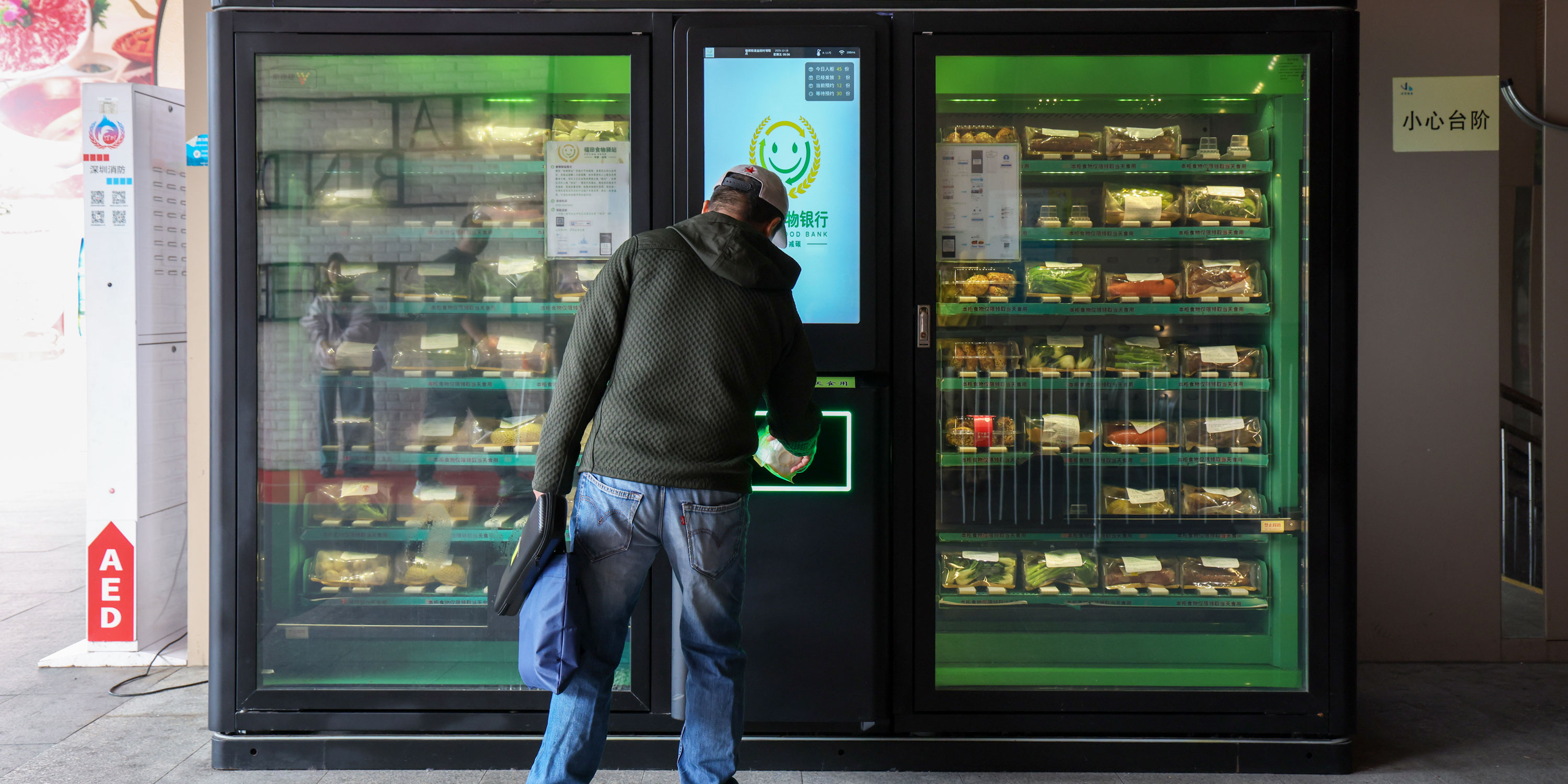
Around 9 on a weekday morning at a community center in China’s southern city Shenzhen, a woman pauses in front of a white cabinet that looks like a vending machine. Using her cellphone, she scans the QR code on the machine, a compartment door clicks open, and she takes out a bag of leafy greens and a bag of steamed buns nearing their sell-by dates.
It looks like any quick, on-the-go purchase, but with one exception: no price pops up on the screen.
The woman receives the city’s minimum living allowance, and this is not a typical vending machine — it’s China’s latest, high-tech food bank. At this food bank, there is no line, no clipboard, and no one at the counter asking about her situation.
Originating in late-1960s America, food banks were first organized as a pragmatic solution to an enduring urban contradiction: supermarkets and manufacturers discarded perfectly edible food, while struggling families went hungry. Functioning as logistics hubs, food banks collect surplus food from farms, households, and retailers; sort and store it in centralized facilities; and then redistribute it through a network of charities, churches, and community groups.
In China, food banks are a relatively new concept. And Shenzhen, China’s “Silicon Valley,” is approaching such redistribution from an alternative angle. Lacking a network of centuries-old church-affiliated charities and widespread grassroots NGOs, this tech hub has moved food banks to the cloud. Initiated by the local government and supported by enterprises, it operates as a centralized platform that uses data and smart cabinets to connect market surplus with community needs, transforming ad-hoc charity into a precise, scalable, and dignified public utility for its 20 million residents.
Across the city’s Futian District, 22 such machines have been installed, mostly at community service centers or on street corners near subway exits to ensure easy access. Over the past three years, the program has received close to half a million donated items from dozens of corporate partners. Suppliers include tech-driven, Alibaba-founded grocer Hema Fresh and more traditional names like the Great China Sheraton Hotel.
Volunteers screen the — often near-expiration — donations to ensure food safety, after which dedicated staff use cold-chain transport to deliver the goods across the district throughout the day. The cabinets themselves are also cooled.
During the day, access is restricted to residents that the local subdistrict governments have identified as vulnerable, including low-income households, people with disabilities, and sanitation workers. After 8 p.m., the platform opens reservations to Shenzhen’s entire population, a clever mechanism to ensure nothing goes to waste. Residents can reserve items online to avoid making a fruitless trip.
When someone registers with the food bank app, it verifies their eligibility against a government database. This way, vulnerable individuals can access services based on clear rules and maintain their anonymity and dignity. They avoid the stigma of having to line up or plead their case while their neighbors are watching. The cabinets are installed in quiet corners, and using them takes just seconds.
However, a system is only as good as its inputs. The next challenge for Shenzhen’s food banks is building a steadier flow of donations. In a functioning community system, there is a feedback loop: when a neighbor shares food, they receive gratitude or social capital in return. In the current market setup, supermarkets and restaurants lack this incentive. Currently, companies are incentivized to participate largely through government encouragement and to boost their Environmental, Social, and Governance (ESG) metrics.
Yet, convincing more businesses to join remains difficult. Donating food involves logistical costs and, crucially, legal anxiety. Because China currently lacks a comprehensive, national “Good Samaritan” law specifically shielding food donors, companies operate in a legal gray area. Despite the food being screened, many potential corporate donors fear that if a recipient happens to get sick, the original brand could still face public backlash or legal liability. Just throwing food away is less risky.
This is where the “Shenzhen Model” meets the harder task of scaling up. The government has built the digital platform, but expanding the donor base will require clearer incentives and protections; it must change the legal rules of the game. To make this system sustainable, Shenzhen needs to move beyond simple distribution and start cultivating “social agency,” meaning it must give all players, from corporate supermarkets to residents, a compelling, intrinsic reason to participate and keep the system running.
First, food donation laws should expand protections to reduce liability risks. Donors would still be accountable if they knowingly donate unsafe food or act with gross negligence, but safeguards, such as secondary screening and temperature-controlled storage used in Shenzhen, can maintain food safety while encouraging more businesses to participate.
Second, the system needs to generate “value” for donors. Since they aren’t getting paid in cash, they need to be paid in data or reputation. Imagine if a supermarket could see a dashboard showing not just how much food they donated, but how many tons of carbon emissions they saved, or how many meals they provided to their specific subdistrict. Integrating these metrics into corporate ESG scores or tax incentives would create a powerful “positive feedback loop,” making donation a rational market choice.
Finally, we must not let technology completely displace human connection. While the front-end user experience is designed to be “contactless,” back-end operations depend heavily on real people. In China, local neighborhoods are managed by armies of social workers, community volunteers, and “grid managers,” hyper-local administrators who intimately know the specific struggles of the families on their block. The smart cabinets rely on this human infrastructure. These local organizers help elderly residents navigate the app, identify proud families who might be hesitant to apply, and organize food deliveries.
Furthermore, the food inside the cabinets isn’t always corporate surplus; it can also carry a deeply personal touch. A prime example is Shenzhen’s “Old Soldier Steamed Buns” initiative, active since 2023 and added to the food bank system last year, in which a local military veteran donates batches of his handmade steamed buns. When a struggling resident scans the machine and receives food made specifically for them by a respected neighborhood elder, the platform ceases to be just a cold logistical pipe and becomes a cultural vessel, proving that even a digital, automated system can foster a culture of community mutual aid.
Shenzhen’s opportunity lies in a hybrid approach, grafting its high-tech backbone onto society’s existing care networks. By redefining the food bank as a formal municipal utility, the city has successfully built the essential digital “hardware.” The next step is to build the “software”: clearer rules, stronger institutions, and deeper community support to reduce corporate legal anxiety and give more players reason to take part. If successful, it could offer other megacities a blueprint for ensuring that no one, and nothing edible, goes to waste.
With contributions from Xu Chenjia, an anthropologist at South China Normal University, Guangzhou.
(Header image: A man receives food from a food bank machine, Shenzhen, Guangdong province, December 2025. Liang Xu/Xinhua)